
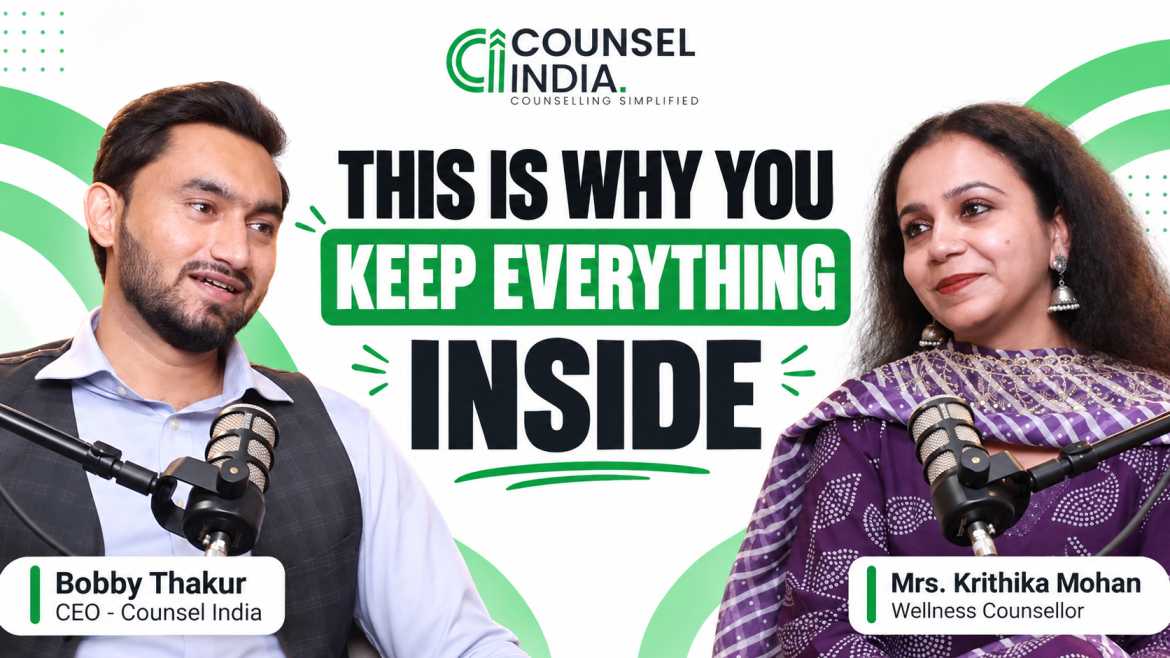
An insightful conversation with Mrs. Krithika Mohan and Bobby Thakur on emotional pain, fear of judgment, and the courage to seek help.
“I'm fine.”
Two simple words we hear almost every day.
We say them when someone asks how we're doing. We say them at work, around friends, and sometimes even to the people who love us the most.
But how often do those two words reflect what we're actually feeling?
Imagine someone who wakes up every morning, goes to work, smiles at colleagues, completes responsibilities, and returns home appearing perfectly normal.
From the outside, everything seems fine.
But internally, that person may be struggling with anxiety, emotional exhaustion, loneliness, unresolved experiences, or overwhelming thoughts.
They want to talk to someone.
They want to feel understood.
But something stops them.
“What if people judge me?”
“What if nobody understands?”
“What if sharing my problems makes me look weak?”
And once again, they choose silence.
This raises an important psychological question:
Why do people sometimes find it easier to suffer silently than to ask for help?
This is the central theme of an insightful Counsel India podcast conversation featuring Mrs. Krithika Mohan, hosted by Bobby Thakur.
The conversation invites us to reflect on emotional vulnerability, the fear of judgment, and the importance of creating spaces where people feel safe enough to express what they are going through.
Human beings have a natural need for emotional connection, understanding, and acceptance.
Yet many people grow up learning that expressing difficult emotions is something they should avoid.
Consider the messages we sometimes hear:
“Don't cry.”
“Be strong.”
“Stop overthinking.”
“Other people have bigger problems.”
Although these statements may not always be intended to cause harm, repeated experiences of emotional dismissal can teach people to suppress their feelings.
Over time, they may begin to associate emotional expression with embarrassment, rejection, or weakness.
As a result, hiding pain can become a protective habit.
Instead of asking, “Who can help me understand what I'm feeling?”, they begin asking, “How can I make sure nobody notices?”
The important insight is that emotional silence does not necessarily mean emotional strength. Sometimes, it reflects a fear of being misunderstood.
Imagine finally gathering the courage to tell someone that you've been struggling emotionally.
But before you speak, several thoughts appear:
What if they think I'm overreacting?
What if they tell someone else?
What if they don't take me seriously?
What if they start treating me differently?
For some people, the anticipated reaction feels more frightening than continuing to deal with the problem alone.
This is one reason why mental health stigma can become a barrier to seeking support.
People may worry about how friends, family members, colleagues, or society will perceive them.
They may also experience self-stigma, where negative beliefs about mental health become part of how they judge themselves.
Someone might begin to believe:
“I should be able to handle this on my own.”
But needing emotional support is not evidence of personal failure.
Seeking help is not the opposite of strength. It can be one way of practising it.
Recognising when something is affecting your wellbeing requires self-awareness, and choosing to address it can require considerable courage.
We often assume that confident, successful, independent people must be emotionally secure.
But psychological distress does not always appear in obvious ways.
A person may be professionally successful while privately experiencing stress, sadness, or emotional difficulties.
Someone who constantly supports others may find it difficult to ask for support themselves.
Why?
Because they may have built an identity around being the dependable one.
The person who solves problems.
The person who never complains.
The person everyone turns to.
And eventually, they begin to believe they must always remain strong.
This can create an exhausting emotional contradiction:
They are available for everyone else, but struggle to allow anyone to be there for them.
An important lesson is that being capable of handling responsibilities does not mean someone should have to handle every emotional difficulty alone.
Even the people who appear strongest deserve care, understanding, and support.
Talking to a friend and seeking professional psychological support can feel like two very different decisions.
Some people hesitate because they are unfamiliar with how counselling works.
Others may wonder:
“Will the counsellor judge me?”
“Does seeking therapy mean something is seriously wrong with me?”
“What if I don't know how to explain my feelings?”
“What if talking about painful experiences makes things worse?”
These concerns are understandable.
For someone who has never experienced counselling, the process may feel unfamiliar or intimidating.
However, psychological counselling is generally intended to provide a structured, supportive space where people can explore their thoughts, emotions, behavioural patterns, and concerns.
A qualified professional can help someone better understand their experiences, develop coping skills, and consider healthier ways of responding to challenges.
Professional support is not about having someone make every life decision for you.
It is about developing a better understanding of yourself and finding constructive ways to navigate difficulties.
Seeking counselling does not automatically mean someone has a mental health disorder.
People may also seek support for relationship challenges, grief, stress, life transitions, emotional regulation, or personal growth.
Imagine someone saying:
“I've been feeling emotionally exhausted lately.”
And receiving the response:
“You're thinking too much. Just stay positive.”
The intention may be good, but the person sharing their pain might feel dismissed.
Not every emotionally difficult conversation requires an immediate solution.
Sometimes, what someone needs first is to feel heard.
Rather than rushing to give advice, we can try responding with:
“That sounds difficult. Would you like to talk about what's been happening?”
Or:
“I'm here to listen. You don't have to explain everything at once.”
These responses do not promise to solve the person's problem.
Instead, they communicate understanding, patience, and emotional availability.
And that can make a meaningful difference.
When people feel less afraid of being judged, opening up may become easier.
This is an important lesson not only for counsellors and psychology learners, but also for parents, partners, friends, colleagues, and leaders.
For someone who has spent years hiding difficult emotions, expressing them may not feel natural.
And that's okay.
Emotional openness does not have to begin with sharing everything at once.
It can begin with small, manageable steps.
Acknowledge what you're feeling.
Instead of immediately dismissing your emotions, try identifying them.
Are you overwhelmed, disappointed, lonely, anxious, or emotionally exhausted?
Naming the experience may help you understand what needs attention.
Choose someone you feel safe talking to.
You don't have to share personal struggles with everyone.
Start with someone who has demonstrated kindness, respect, and an ability to listen without judgment.
Communicate what kind of support you need.
You might say:
“I've been going through something difficult. I don't need advice immediately. I just need someone to listen.”
Consider professional support when needed.
If emotional difficulties are persistent, overwhelming, or affecting your relationships, sleep, work, or daily functioning, speaking with a qualified mental health professional may be helpful.
Most importantly, remember that becoming emotionally open is a process.
There is no requirement to share more than you feel ready to share.
The theme of Counsel India's podcast with Mrs. Krithika Mohan encourages us to reconsider some of our assumptions about emotional pain and help-seeking.
Here are five key reflections worth carrying into everyday life:
1. Silence doesn't always mean someone is okay.
A person can appear cheerful and productive while experiencing emotional difficulties.
2. Fear of judgment can become a barrier to seeking help.
The way society, families, and communities respond to vulnerability matters.
3. Emotional strength does not require constant self-reliance.
Knowing when to ask for support is an important life skill.
4. Listening can be more valuable than immediately offering advice.
Emotional safety begins with empathy, patience, and respect.
5. Seeking psychological help should be normalised, not stigmatised.
Understanding mental health and accessing appropriate support are important parts of overall wellbeing.
Whether you're a psychology student, aspiring counsellor, working professional, parent, or someone struggling to express difficult emotions, understanding this topic can help you develop a more compassionate perspective.
You may begin to recognise why you hesitate to share certain feelings, understand how fear influences help-seeking behaviour, and become more mindful of how you respond when others open up.
For psychology and counselling learners, this topic also highlights the importance of empathy, active listening, emotional validation, confidentiality, and a non-judgmental approach when supporting people experiencing emotional distress.
These are valuable principles for building trust and creating meaningful human connections.
The next time someone says they're fine, remember that you may not know everything they're experiencing.
And the next time you feel tempted to hide your own struggles because you're afraid of being judged, remember this:
You don't have to prove your strength by suffering in silence.
We live in a world where people are often encouraged to appear confident, successful, and emotionally strong.
But perhaps one of the most meaningful things we can learn is how to make space for honesty.
To say, “I'm struggling.”
To respond, “I'm listening.”
And to recognise that asking for help is a human need, not something to be ashamed of.
The conversation between Bobby Thakur and Mrs. Krithika Mohan invites us to think beyond the surface of emotional pain and reflect on why people hide it.
Because sometimes, the beginning of healing is not having all the answers.
It's discovering that you don't have to face every difficult moment alone.
At Counsel India, we believe that understanding human behaviour, emotional wellbeing, and psychological experiences can help create a more aware and compassionate society.
Through expert podcast conversations, psychology learning sessions, and counselling education, we aim to make psychological knowledge more accessible, relatable, and practical.
Click Link To Watch Full Podcast Here :- https://youtu.be/3HZ_w5KoTcE
🎙️ Watch the full podcast: “Why Do People Hide Their Pain?” featuring Mrs. Krithika Mohan and Bobby Thakur on the Counsel India YouTube channel.
Counsel India — Counselling Simplified. 💚


Don't have an account yet?
Already have an account?
Don't have an account yet? Sign up


Leave your thought here
Your email address will not be published. Required fields are marked *